Views: 108 Author: Site Editor Publish Time: 2026-07-13 Origin: Site


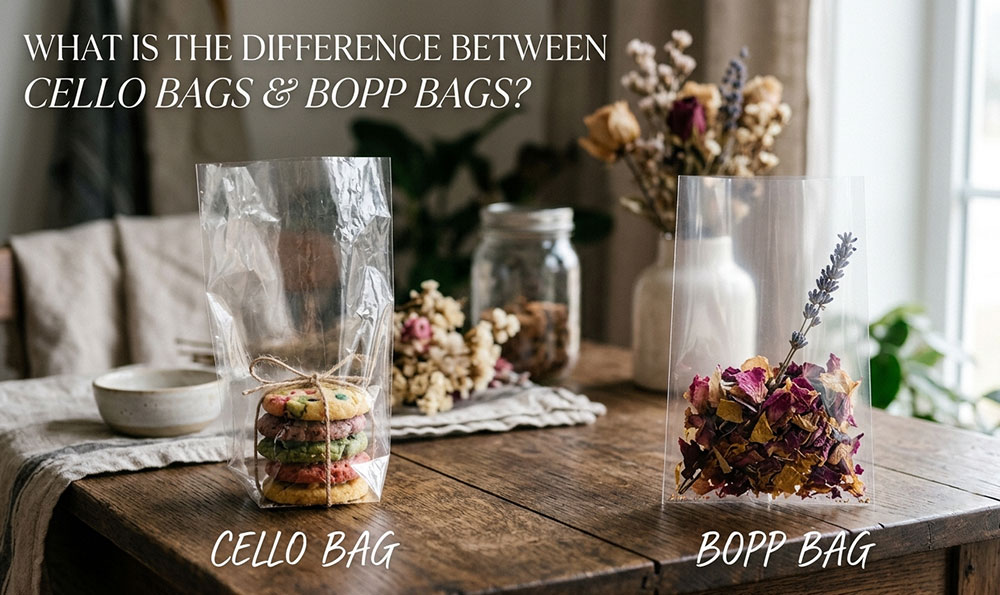
Cello bags and BOPP bags are both used when a brand wants customers to see the product inside the package. On a retail shelf, the two can look very similar: clear, glossy and lightweight.
From a packaging specification point of view, however, they are not the same.
True cello bags are made from regenerated cellulose film, while BOPP bags are made from biaxially oriented polypropylene. This difference affects moisture protection, sealing performance, packing speed, cost and end-of-life claims.
There is also another issue that often causes confusion during sourcing. In many online listings, the term "cello bag" is used loosely for almost any transparent bag, including bags made from BOPP, CPP or polyethylene.
For food brands and packaging buyers, the safest approach is to look beyond the product name and confirm the exact film structure before comparing prices.
The simplest distinction is:
Cello is cellulose-based. BOPP is polypropylene-based.
Cello bags are often chosen for their crisp appearance, natural material story and availability in certified compostable grades. BOPP bags are widely used because they offer reliable moisture resistance, good mechanical strength and efficient performance on high-speed packing lines.
Neither option is automatically better. The correct choice depends on the food being packed, the required shelf life and how the finished package will be filled, sealed and disposed of.
| Packaging Factor | True Cello Bags | BOPP Bags |
| Main material | Regenerated cellulose | Polypropylene |
| Typical raw material source | Wood pulp or other cellulose feedstock | Conventional plastic resin |
| Appearance | Clear, glossy and crisp | Clear, smooth and highly uniform |
| Moisture protection | Limited without a barrier coating | Naturally good moisture resistance |
| Oxygen and aroma barrier | Often good in dry conditions | Depends on coating, grade and laminate |
| Heat sealing | Requires a heat-sealable grade or coating | Widely available in heat-sealable grades |
| Machine performance | Suitable when the correct grade is selected | Commonly used on high-speed packing lines |
| Typical cost | Generally higher | Usually more economical |
| Common uses | Artisan confectionery, gifts and premium dry foods | Cookies, snacks, bakery products and mass retail packaging |
Actual performance should always be checked against the specific film grade. A coated cellulose film can behave very differently from an uncoated one, just as a metallized BOPP film performs differently from a basic clear BOPP film.
In professional packaging terminology, true cello bags are made from regenerated cellulose film, commonly known as cellophane.
The starting material is normally cellulose derived from wood pulp. It is processed into a transparent film and then converted into bags, wraps or roll stock.
Compared with ordinary plastic film, cellulose film has a distinctive crisp feel and tends to hold folds well. This is one reason it remains popular for premium confectionery, bakery gifts and natural product packaging.
Uncoated cellulose film does not normally provide the same moisture protection as BOPP. For cookies, crackers or other products that lose quality when exposed to humidity, a coated cellulose grade is usually required.
The coating matters. A bag should not be described as compostable simply because its base film comes from cellulose. Inks, seal coatings, adhesives, labels and closures all affect the final claim.
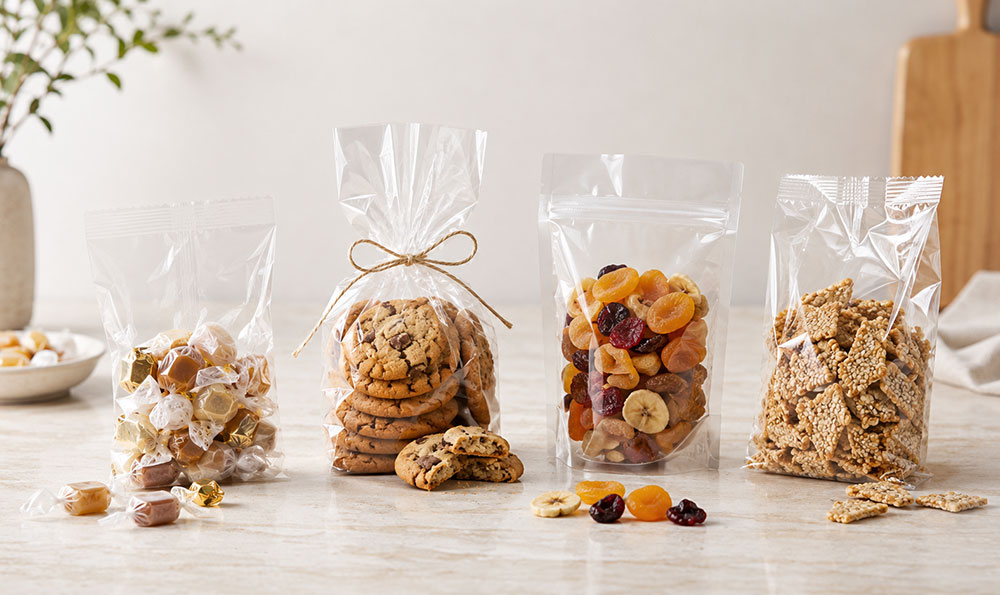
BOPP stands for biaxially oriented polypropylene.
During production, polypropylene film is stretched in both the machine direction and transverse direction. This improves clarity, stiffness, dimensional stability and tensile strength.
BOPP has become one of the most widely used films in flexible food packaging because it performs consistently while remaining relatively lightweight and cost-efficient.
BOPP is often used for cookies, crackers, candy, bakery products, pasta, tea, granola, snack foods and retail overwraps.
It can be supplied as a single film or laminated with other layers to improve sealing, oxygen barrier, puncture resistance or print protection.
Both materials can produce attractive clear packaging.
Cellulose film has a crisp, polished appearance that suits artisan products, organic ranges and premium gift packaging. It also creates a tactile difference that some brands prefer over softer plastic films.
BOPP gives a highly uniform, smooth and glossy finish. It is commonly selected for retail products that need strong visual consistency across larger production volumes.
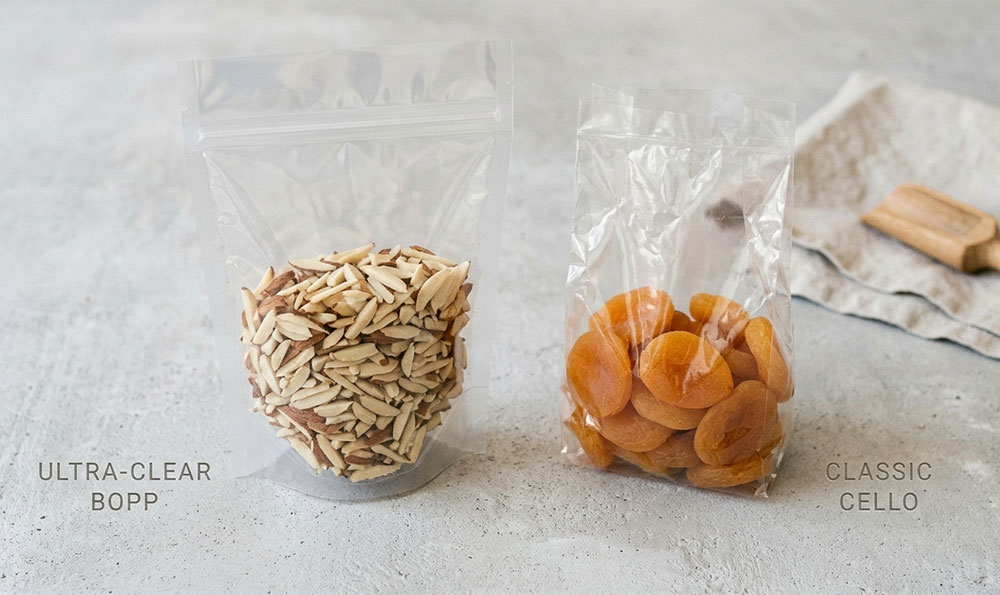
For most consumers, the materials are difficult to distinguish by sight. This makes accurate labeling and supplier documentation especially important.
Moisture barrier is often the deciding factor for dry foods.
Cookies, crackers, cereal and granola can lose crispness when water vapor enters the package. Standard BOPP naturally provides useful resistance to moisture and is therefore widely used for these products.
Uncoated cellulose film is more permeable to water vapor. This does not make it unsuitable, but it means the grade must be matched carefully to the product.
A barrier-coated cellulose film may provide enough moisture protection for certain applications, especially when a compostable packaging direction is important. Shelf-life testing should still be completed with the actual food.
Cellulose film is often valued for its oxygen and aroma barrier, particularly under dry conditions. This can be useful for confectionery, tea and aromatic dry ingredients.
Basic clear BOPP is more commonly selected for moisture protection than for high oxygen barrier. When stronger protection is required, coated, metallized or laminated BOPP structures may be used.
Not every cello film can be heat sealed.
Uncoated cellulose may require adhesive closure, tape, labels, folding or a separate sealant layer. Heat-sealable cellulose grades use specialized coatings that allow them to run on suitable sealing equipment.
BOPP is widely available in co-extruded or coated heat-sealable grades. It generally offers a practical sealing window for automated food packaging.
BOPP generally offers better resistance to tearing, puncture and repeated handling.
Cellulose film has a firm and crisp structure, but some grades may be more sensitive to creasing, humidity or impact.
Both cello and BOPP films can be custom printed.
BOPP is commonly used with gravure and flexographic printing for larger production runs. It can deliver strong color reproduction and consistent registration.
Cellulose films can also be printed effectively, including clear, tinted and metallized versions. When compostability is required, the ink and adhesive systems must be selected with the full structure in mind.
At BioPack, we normally recommend starting with the product and filling process before deciding the bag style. The same film can perform very differently in a flat bag, gusset bag or machine-packed roll stock format.
Are cello bags compostable?
Some are, but not all.
Certified cellulose films are available for home and industrial composting. The final bag, however, must be evaluated as a complete package.
Are BOPP bags recyclable?
Polypropylene is technically recyclable, but the answer depends on the package construction and the recycling system in the destination market.
A single-material or mono-PP package is generally more compatible with polypropylene recycling than a bag laminated with PET, nylon, aluminum foil or incompatible sealant layers.
This does not mean every BOPP bag should carry a recyclable logo. Flexible film collection differs by country, state and municipality.
BOPP bags are usually more economical, especially for medium and large production runs.
The film is widely available, performs well on high-speed equipment and can be converted into many standard packaging formats.
Certified cellulose bags generally cost more. The difference may come from raw material pricing, specialist coatings, lower production scale and certification requirements.
Unit price, however, should not be the only purchasing criterion.
At BioPack, we supply clear and printed flexible packaging for food, coffee, tea, snacks, bakery products and other consumer goods.
Our role is not to recommend cellulose or BOPP based only on appearance. We first review the product and how the package will be used.
Samples and material testing are recommended when barrier or sealing performance is critical.
Is a cello bag the same as a cellophane bag?
The term should refer to a bag made from regenerated cellulose film. In the retail market, however, "cello bag" is often used for BOPP and other clear plastic bags. Always confirm the actual material.
Are cello bags plastic-free?
True cellulose film is not conventional petroleum-based plastic. The finished bag may still contain coatings, adhesives or closures that affect a plastic-free claim.
Is BOPP the same as polypropylene?
BOPP is a polypropylene film that has been stretched in two directions to improve strength, stiffness and clarity.
Which is better for cookies: cello or BOPP?
BOPP is commonly selected for cookies because of its moisture resistance and efficient heat sealing. Coated cellulose may also work when compostability is a priority and the structure passes shelf-life testing.
Can cellophane bags be heat sealed?
Yes, when a heat-sealable coated grade is used. Uncoated cellulose film may require a different closure method.
Are all cellulose bags compostable?
No. Compostability depends on the film grade and every component in the finished package. Certification should be checked for the exact structure.
Can BOPP bags be recycled?
BOPP is made from polypropylene and may be recyclable when used in a compatible mono-material structure. Actual acceptance depends on local flexible-film collection systems.
Is cello suitable for coffee packaging?
A simple clear cellulose bag is normally unsuitable for long-term roasted coffee storage. Coffee usually needs a stronger oxygen and moisture barrier, and whole beans may require a degassing valve.
Which material is more expensive?
Certified cellulose packaging is generally more expensive than standard BOPP. The final price depends on film thickness, coatings, printing, bag format and order quantity.
Can BioPack produce custom printed cello and BOPP bags?
Yes. BioPack can develop custom clear bags, printed pouches and roll stock using cellulose, BOPP and other flexible packaging structures according to the product and target market.
Cello bags and BOPP bags may look similar, but they solve different packaging needs.
True cello bags are made from regenerated cellulose and are worth considering when premium presentation, renewable feedstock and certified compostability are important.
BOPP bags are made from polypropylene and are generally better suited to applications requiring moisture resistance, mechanical strength, high-speed packing and competitive pricing.
The product name alone is not enough to make a purchasing decision.
Ask for the exact material structure, barrier data, sealing conditions and certification before approving the packaging. This is the most reliable way to avoid misleading environmental claims and prevent shelf-life problems after launch.
Not Sure Whether Cello or BOPP Is Right for Your Product?
Send BioPack your product type, filling weight, target shelf life, bag size and destination market. Our packaging team will compare suitable cellulose, BOPP and high-barrier structures for your application. Request Samples and Pricing Today!