 |


| Quantity: | |
|---|---|
BPR016
Biopack
BPR016
customized
100-150U
0.2(25ºC 0%RH)
160(38ºC 90% RH)
PET / NY / RCPP
Product Description
BioPack's recyclable microwavable retort pouches are developed for food manufacturers that need three performance requirements from one flexible package: resistance to thermal processing, reliable barrier and seal performance, and convenient microwave reheating.
For suitable applications, a PP-based mono-material design can replace conventional aluminum-containing retort laminates, making it possible to create an aluminum-free retort pouch designed for recycling while maintaining the heat resistance required for commercially sterilized ready meals, soups, sauces, grains, vegetables, seafood and other shelf-stable foods.
Instead of offering a fixed laminate for every product, BioPack develops each retortable pouch around the food formulation, filling process, retort conditions, required shelf life, microwave instructions and recycling requirements of the destination market.
A recyclable microwavable retort pouch is a heat-resistant, aluminum-free flexible package designed to survive retort processing and allow the packaged food to be reheated in a microwave. PP-based mono-material structures are one practical development route because polypropylene provides higher temperature resistance than conventional PE-based recyclable films. Final recyclability, food-contact suitability and retort performance must still be verified for the complete pouch and its intended market.
Retort resistance: Retort-grade PP-based films and sealant layers
Microwave reheating: Aluminum-free, non-metallic structure unless a specialized microwave technology is separately validated
Oxygen barrier: Retort-resistant high-barrier film or coating
Moisture barrier: PP-based barrier structure selected for the food
Seal integrity: Retort-compatible sealing layer and optimized sealing window
Recyclability: Predominantly mono-PP structure designed around relevant recycling guidelines
Printing: Reverse printing to protect graphics during processing and distribution
Format: 3-side-seal, flat pouch, stand-up pouch or other application-specific configuration
BioPack supports packaging development for both new products and conversions from conventional retort structures.
Available customization can include:
Pouch Formats
Printing & Branding
Convenience Features
Features are evaluated individually because every additional material or component can affect retort performance, microwave suitability and recyclability.
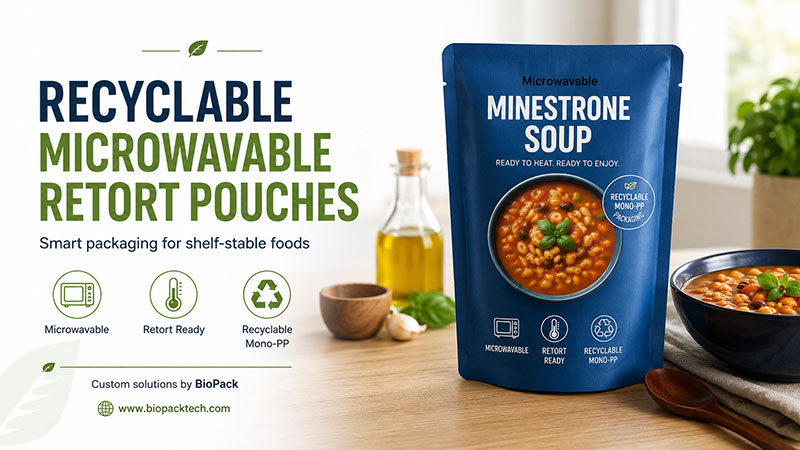
Choosing a retort pouch should begin with the processing conditions rather than a generic pouch catalog.
BioPack works with food brands and food processors to balance four requirements that often compete with one another:
The package must provide sufficient barrier and sealing performance for the intended shelf life.
Films, adhesives, inks and seals need to survive the specified filling and thermal process.
Microwavable formats should support practical reheating and easy opening.
Where technically feasible, predominantly mono-material PP structures can reduce the complexity associated with conventional mixed-material retort laminates.
The result is a packaging specification built around the actual product rather than a one-structure-fits-all recommendation.
Are retort pouches microwavable?
Some are, but not all. Traditional retort pouches containing aluminum foil are not the standard choice for direct microwave reheating. A microwavable retort pouch normally requires an aluminum-free structure specifically developed and validated for the intended heating conditions.
Can recyclable retort pouches withstand 121°C?
PP-based mono-material retort technologies are available for applications around 121°C, but the allowable temperature and processing time depend on the complete laminate, adhesive system, pouch configuration and food process. Commercial examples of PP-based mono-material retort packaging designed for approximately 121°C are already available in the market.
What material is best for a recyclable retort pouch?
For high-temperature retort applications, PP-based mono-material structures are currently one of the most practical development routes because polypropylene combines heat resistance with compatibility with PP-oriented recycling design guidelines. The barrier layer, coating, adhesive and printing system must also be considered.
Are mono-PP retort pouches recyclable everywhere?
No. "Mono-material" does not mean a pouch will be collected and recycled in every municipality or country. Recycling claims should be based on the full structure and the relevant collection, sorting and recycling system in the destination market.
Can you replace an aluminum retort pouch with a recyclable version directly?
Not without testing. Removing aluminum changes oxygen barrier, light barrier, stiffness and thermal behavior. The alternative structure should be validated against the actual food, retort cycle, filling line and shelf-life requirement.
What shelf life can a retort pouch provide?
Shelf life cannot be guaranteed from the pouch specification alone. It depends on the food formulation, barrier requirement, thermal process, residual oxygen, storage conditions and package integrity. Shelf-life testing should be performed using the final packed product.
Developing a ready meal, sauce, soup or other shelf-stable food that needs retort processing, microwave convenience and a more recyclable packaging structure?
Send BioPack your product information, pouch size, fill weight, retort temperature/time, microwave requirements and target market.
BioPack can help evaluate the appropriate pouch structure, barrier level, sealing layer and format before you move into production trials. Request a Retort Pouch Sample & Material Recommendation.