|


| Size: | |
|---|---|
| Quantity: | |
VSB2402
BioPack
VSB2402
customized
up to 10 colors
Custom Printing
customized
cellophane+PBAT/ Compostable SAP/ Cellophane+PBAT
Product Description

Fresh fish and shellfish can release a significant amount of liquid during processing, storage and transport. When that liquid remains visible inside the tray, it can affect presentation, increase leakage risk and create a stronger odour when the package is opened.
BioPack supplies compostable odour-absorbent pads for seafood packaging, developed to capture seafood drip while helping control unwanted pack odours. Pad size, absorption capacity, thickness and material construction can be adjusted for fish fillets, salmon, shrimp, shellfish and other chilled seafood products.
Unlike standard tray pads selected only by dimensions, our seafood pads are specified according to the product weight, expected drip volume, tray format, storage conditions and target disposal route.
Compostable odour-absorbent pads are placed beneath seafood products to absorb exudate and maintain a cleaner package. BioPack develops customised pads using plant-fibre absorbent cores, compostable cover materials and optional odour-control components for chilled fish and shellfish packaging.
Seafood packaging requires more than a general-purpose absorbent sheet. Fish exudate can contain water, oils, proteins and salts, and the volume released varies widely between species and processing methods.
A thawed shrimp product may require rapid liquid intake, while a salmon portion may need stronger retention over a longer chilled storage period. Smoked, seasoned or marinated seafood can also require a structure capable of handling both moisture and oils.
BioPack develops each pad around the actual application, helping seafood processors and packaging distributors achieve:
Less free liquid at the bottom of the tray
Cleaner presentation during retail display
Reduced movement of liquid in transport
Better separation between the seafood and absorbed exudate
Lower risk of pad rupture or fibre exposure
Improved control of unpleasant odours inside the package
The pad does not mask odour with added fragrance. An optional internal odour-control component captures selected odour-causing compounds while the absorbent core manages liquid.
Our compostable seafood pads can be used for:
Fresh fish fillets and portions
Salmon, tuna, cod and white fish
Shrimp and prawns
Crab and lobster meat
Scallops, mussels and other shellfish
Smoked or seasoned seafood
Thawed frozen seafood
Retail seafood trays
Seafood transport boxes and insulated containers
Pads can be designed for shallow retail trays, vacuum skin packaging systems, lidded trays and larger bulk seafood containers.
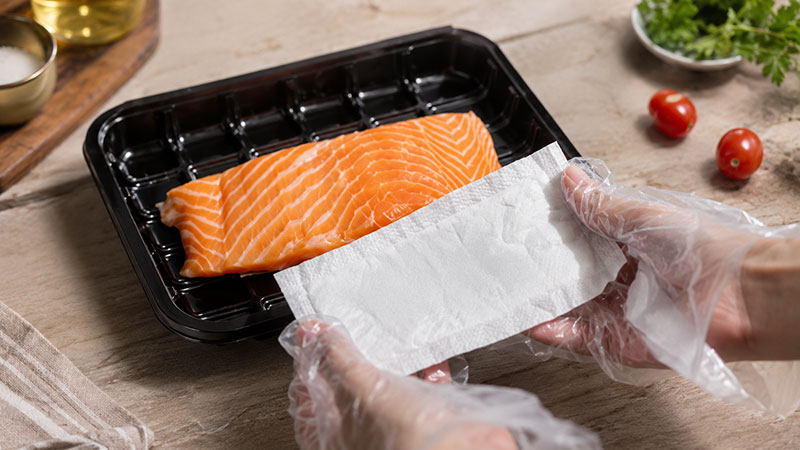
The project begins with the seafood type, tray size, pack weight, storage condition and expected shelf life.
BioPack recommends a starting pad structure and suitable absorption range based on the available information.
Samples can be tested with the actual seafood product for tray fit, liquid intake, retention and odour-control performance.
Core weight, pad dimensions or functional layers can be changed according to the test results.
Once the pad specification and required documentation are approved, production follows the confirmed quality and packing requirements.
Are the pads fully compostable?
Compostable options are available, but the final claim depends on the complete pad structure. The cover film, absorbent core, sealing layer and odour-control component must all be included in the assessment.
How does the pad control seafood odour?
An enclosed activated-carbon or mineral-based layer can capture selected odour-causing compounds inside the package. It works together with the absorbent core and does not use added fragrance to cover the smell.
Can activated carbon touch the seafood?
The activated carbon is normally enclosed inside the pad. Food-contact-compatible external layers and sealed edges help prevent direct contact or particle release.
Can the pad be used for salmon?
Yes. Pad size and capacity can be adjusted for salmon fillets, portions and steaks. The correct grade depends on product weight, drip volume and storage time.
Are these pads suitable for shrimp and shellfish?
Yes. Thin and high-absorbency structures are available for shrimp, prawns, scallops, crab and other shellfish applications.
Can the pads be used for frozen seafood?
They can be developed for frozen or freeze-thaw applications, but the final construction should be tested through the actual freezing, storage and thawing cycle.
Do absorbent pads extend seafood shelf life?
The pad helps manage free liquid and maintain a cleaner package environment. Actual shelf life also depends on seafood quality, hygiene, storage temperature, sealing, barrier performance and cold-chain control.
Shelf-life claims should be supported by product-specific testing.
Can BioPack make a custom tray size?
Yes. Pad dimensions, thickness, absorbency, shape and edge sealing can be customised.
Can we receive samples before ordering?
Yes. Samples can be prepared for tray-fit, absorption, retention and odour-control testing.
A seafood absorbent pad should be selected around the product, not treated as a generic accessory.
BioPack works with seafood processors, food brands and packaging distributors to develop custom compostable odour-absorbent pads that meet the required tray size, absorption level, food-contact standard and sustainability target.
Send us your seafood type, tray dimensions and estimated order quantity to receive a recommended specification, sample options and quotation.
Request a Custom Seafood Pad Specification.