|




| Size: | |
|---|---|
| Quantity: | |
EFB23478
BioPack
EFB23478
customized
up to 10 colors
Custom Printing
customized
PFAS FREE
Product Description
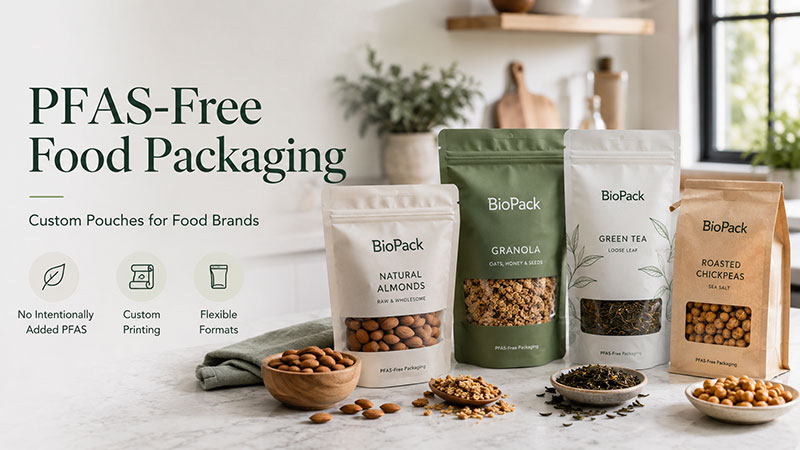
Food packaging still needs to resist grease, moisture and oxygen after PFAS-based treatments are removed. The challenge is not simply finding a material labelled "PFAS-free." It is developing a complete packaging structure that protects the product, seals reliably and meets the requirements of the destination market.
BioPack supplies custom PFAS-Free Food Packaging for food manufacturers, coffee roasters, snack brands, pet food companies and packaging distributors. Our range includes printed pouches, sachets, flat-bottom bags and rollstock film made with materials specified without intentionally added PFAS.
Depending on the product, we can develop recyclable mono-material, high-barrier, paper-look or selected compostable structures. Size, barrier level, printing, closures and functional features can be tailored to your filling process and shelf-life target.
Request a Material Recommendation.
BioPack manufactures custom PFAS-free food packaging for coffee, tea, snacks, powders, bakery products, frozen foods and pet treats. Available formats include stand-up pouches, flat-bottom bags, sachets, side-gusset bags and printed rollstock film.
Packaging structures are developed without intentionally added PFAS and can be customized for oxygen, moisture, aroma and grease protection. Recyclable mono-PE, MDO-PE, high-barrier laminate, paper-look and selected compostable options are available.
For compliance-sensitive projects, BioPack can support material declarations, food-contact documentation and third-party PFAS or fluorine testing based on the finished packaging specification.
PFAS-free packaging generally refers to packaging manufactured without the intentional use of per- and polyfluoroalkyl substances in its materials or functional treatments.
PFAS have historically been used in some food packaging to improve resistance to oil, grease, moisture and heat. They have been most commonly associated with grease-resistant paper and paperboard, although a complete assessment should also consider coatings, inks, adhesives and packaging accessories.
There is currently no single global definition that proves a package contains absolutely zero PFAS molecules. Laboratories test different PFAS lists, use different reporting limits and may measure targeted PFAS, total fluorine or extractable organic fluorine.
For commercial packaging projects, BioPack uses the following approach:
No intentionally added PFAS in the agreed packaging structure, supported by supplier documentation and testing where required.
This provides a clearer and more defensible specification than an unsupported “zero PFAS” claim.
Custom stand-up pouches are suitable for snacks, nuts, dried fruit, granola, powders, confectionery and pet treats.
They can be supplied with resealable zippers, tear notches, hang holes, clear windows and custom printing.
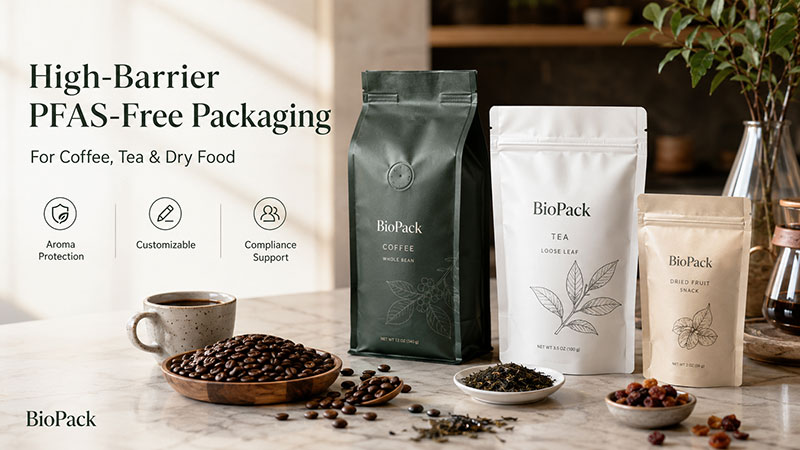
Flat-bottom bags provide a stable base and five printable panels. They are commonly used for coffee, tea, matcha, specialty foods, pet treats and nutritional powders.
Degassing valves and resealable closures can be added where required.
These formats offer efficient volume and strong shelf presentation for coffee, grains, bakery ingredients, dry foods and larger product fills.
Three-side-seal pouches and sachets are suitable for single servings, samples, seasonings, powders, confectionery and frozen food portions.
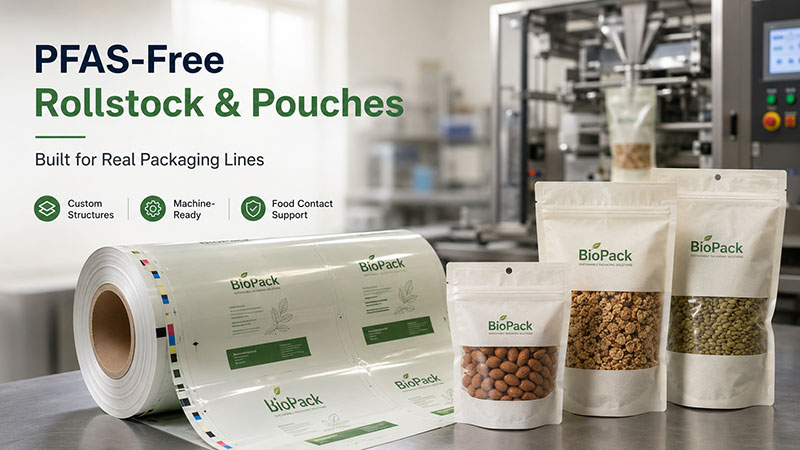
PFAS-free rollstock film can be designed for vertical form-fill-seal, horizontal form-fill-seal and other automated packaging systems.
Roll width, repeat length, core diameter, winding direction, coefficient of friction and sealant layer can be adjusted to match the packing machine.
Mono-PE and MDO-PE packaging can provide a recyclable pathway for suitable food applications while maintaining moisture resistance, printability and seal performance.
PP-based structures may be considered where the application requires clarity, stiffness or a particular sealing and temperature performance.
For products sensitive to oxygen, moisture, aroma or light, BioPack can develop multilayer structures using non-fluorinated barrier technologies.
Paper-look laminates can create a natural, premium appearance without relying on fluorinated grease-resistant treatments.
Certified compostable materials may be available for certain dry-food and specialty-food applications.
PFAS status and compostability are separate requirements. Films, inks, adhesives, zippers and coatings must all be reviewed before both claims can be made.
A raw film declaration alone may not be enough to support a claim for the finished package.
Printing inks, adhesives, coatings, sealant layers, zippers and valves can all form part of the final packaging specification. For this reason, BioPack recommends reviewing the complete bill of materials.
Depending on the project, the compliance file may include:
Material specifications
Supplier PFAS declarations
Food-contact declarations
Migration test reports
Targeted PFAS analysis
Total fluorine screening
Barrier and seal-performance reports
Finished packaging samples
Before testing, the parties should agree on the PFAS definition, analyte list, reporting limit, sample type and applicable regulation.
A laboratory "non-detect" result means the tested substances were not detected above the stated reporting limit. It should not be interpreted as proof of absolute molecular zero.
Our assessment is not limited to the outer paper or base film. Relevant coatings, inks, adhesives, sealant layers and accessories can also be included in the packaging specification.
Material recommendations are based on grease content, moisture sensitivity, oxygen exposure, shelf life and filling conditions.
This reduces the risk of choosing a visually sustainable package that does not provide adequate product protection.
BioPack can compare recyclable mono-material, high-barrier laminate, paper-look and selected compostable solutions.
Customers can evaluate performance, cost, appearance and end-of-life requirements before selecting a structure.
Digital printing is available for selected lower-volume and multi-SKU projects. Rotogravure and flexographic printing support larger orders that require consistent color and competitive unit costs.
Where PFAS or fluorine testing is required, the method and acceptance criteria should be confirmed before the packaging is printed.
This helps prevent disputes caused by different definitions, laboratories or reporting limits.
For customers replacing an existing package, our team can review the current sample, material specification, shelf-life target and filling-machine information before proposing an alternative.
The purpose is not simply to remove one chemical treatment. It is to maintain product protection and production efficiency during the conversion.
Is PFAS-free packaging guaranteed to contain zero PFAS?
An absolute zero claim is difficult to support because laboratory methods have defined analyte lists and reporting limits.
BioPack normally specifies packaging as made without intentionally added PFAS, with additional third-party testing arranged where required.
Is recyclable packaging automatically PFAS-free?
No. Recyclability and PFAS content are separate packaging characteristics. Both should be evaluated using the complete finished structure.
Is compostable packaging automatically PFAS-free?
No. Compostability certification does not automatically confirm that no PFAS have been intentionally added to coatings, inks, adhesives or accessories.
Can paper packaging resist grease without PFAS?
Yes. Non-fluorinated coatings, functional films and other barrier technologies can provide grease resistance.
The correct option depends on the food’s oil content, temperature, contact time and required shelf life.
Can BioPack provide PFAS test reports?
Third-party testing can be arranged based on the agreed finished packaging, analytical method, PFAS list and reporting limit.
Testing requirements should be confirmed before mass production.
Can you meet EU PPWR PFAS requirements?
Packaging can be developed and tested against the PFAS limits applicable to food-contact packaging under Regulation (EU) 2025/40.
Compliance must be confirmed for the specific finished structure rather than assumed from a material name or supplier statement.
Can PFAS-free packaging provide high oxygen and moisture barriers?
Yes. Non-fluorinated high-barrier films and coatings can be used for oxygen-, moisture- and aroma-sensitive products.
The required OTR and WVTR should be determined from the product and shelf-life target.
Can the packaging run on our existing machine?
Rollstock and pre-made pouch specifications can be adjusted for the machine’s sealing range, web width, repeat length, core size, winding direction and coefficient of friction.
A production trial is recommended before placing a large order.
What is the minimum order quantity?
Selected digitally printed pouches may start from approximately 1,000 pieces. Gravure-printed projects generally start from approximately 10,000 pieces.
Actual MOQ depends on the material, size, accessory and number of designs.
Should we conduct shelf-life testing?
Yes, particularly when changing from an existing material.
Laboratory barrier data supports material selection, but actual shelf life is also influenced by the product, residual oxygen, sealing quality, filling process and storage conditions.
Changing to PFAS-free food packaging should not mean compromising shelf life, packaging appearance or production efficiency.
BioPack can help you compare material options, define the required PFAS specification and prepare packaging samples for product or machine testing.